


What Is a Bolt? The Ultimate Guide to Bolt Types, Grades, Manufacturing, and More
Aug. 07, 2025
Bolts are fundamental components in both manufacturing and engineering. They are used across a wide range of applications—from the complex mechanisms within automobiles to the structural integrity of bridges and buildings. Their primary function is to securely fasten materials together, making them indispensable to countless industries. Because of their critical role, it's essential to understand what bolts are, including the different types, grades, naming conventions, and specific uses associated with them.
Definition of a Bolt
A bolt is an externally threaded fastener designed to be inserted through aligned holes in assembled parts and secured by tightening a corresponding nut. Its primary function is to create a strong, removable joint between two or more components.
While bolts come in many varieties, they generally share a few key features: a threaded cylindrical shaft, a head at one end (often hexagonal or square), and typically a nut used at the opposite end to clamp components together. The head is usually wider than the body, helping to distribute load more evenly across the joined surfaces.
Bolts are widely used in construction, manufacturing, automotive, and many other industries that require strong, reliable, and adjustable connections
The Difference Between a Bolt and a Screw
Bolts and screws are often confused due to their similar appearance and function—but there are subtle differences that help distinguish the two. So, how can you tell them apart?
The truth is, there’s no universally accepted definition that separates bolts from screws, and even industry professionals sometimes disagree. However, one commonly referenced source is the U.S. Customs and Border Protection (CBP) Agency, which offers the following distinctions:
A bolt is an externally threaded fastener designed to pass through holes in assembled parts and is typically tightened or loosened using a nut.
A screw is also externally threaded but is designed to either mate with a preformed internal thread or form its own thread within a material, and is typically tightened or released by turning the head of the fastener.
As you can see, the differences are nuanced. The CBP also outlines 13 additional primary and supplementary criteria to differentiate between the two, which we explore further in our full blog post.
How Is a Bolt Made?
Bolts are typically manufactured using one of three main methods: cold forming, hot forging, or machining. Each process has its own advantages and is selected based on the application and required specifications.
Cold Forming: This method shapes the bolt without heating the material. Instead, the metal is struck or pressed into a die at room temperature to form the desired shape. Cold forming is highly efficient and produces strong, high-quality bolts with excellent grain structure.
Hot Forging: In this process, the material is heated until it becomes malleable, then formed in a die. Hot forging is useful for producing larger bolts or bolts with complex shapes, as the heat makes the metal easier to shape.
Machining: This method involves cutting away excess material using specialized tools until the bolt reaches its final dimensions. While not as efficient for high-volume production, machining allows for high precision and is ideal for custom or low-quantity runs.
At Wilson-Garner, we primarily use cold forming due to its ability to deliver superior strength and consistent quality. However, we also employ machining when needed to meet unique design or tolerance requirements.
Common Types of Bolts
Bolts come in a wide range of styles, each designed for specific applications and performance requirements. Below are some of the most commonly used types:
Place Bolts: Equipped with self-locking, free-spinning hex heads, place bolts are designed to resist loosening due to vibration.
Carriage Bolts: Recognizable by their domed heads and square necks, carriage bolts have reduced body diameters and are typically used in wood-to-metal or wood-to-wood applications.
Hex Bolts: Featuring six-sided (hexagonal) heads, hex bolts are widely used in construction and machinery. They provide excellent torque and are easy to install with standard tools.
Flange Bolts: These bolts include an integrated washer-like flange under the head, which helps distribute the load more evenly, reducing the need for a separate washer.
Shoulder Bolts: Also known as stripper bolts, these feature a smooth, cylindrical shoulder between the head and the threaded portion. The shoulder is often larger in diameter and is used as a pivot or shaft for moving parts.
Machine Bolts: Identified by their square heads and semi-cone tips, machine bolts are designed for precise alignment and secure fastening in heavy-duty applications.
Custom Bolts: Also known as special bolts, these are engineered and manufactured to meet unique requirements or non-standard specifications.
Understanding Bolt Grades
Bolt grades indicate the material composition and strength of a bolt, helping determine how much stress it can safely withstand. In general, the higher the grade number or classification, the greater the tensile strength and load capacity of the bolt.
Several international and national standards organizations define bolt grades. The most widely used systems include:
SAE (Society of Automotive Engineers): Commonly used for inch-based fasteners. The SAE J429 standard outlines Grades 2, 5, and 8 — with Grade 8 offering the highest strength of the three.
ISO (International Standards Organization): Often referred to as metric standards, ISO bolt grades are called property classes. Common classes include 8.8, 10.9, and 12.9, with Class 12.9 providing the highest tensile strength.
ASTM (American Society for Testing and Materials): This system covers a broad range of fasteners, including bolts. Common ASTM standards include ASTM A307 (low-strength), ASTM A193 (high-temperature and pressure), and ASTM A354 (high-strength structural applications).
Why It Matters: Choosing the correct bolt grade is critical for safety and performance. For example, an SAE Grade 2 bolt cannot replace an ISO Class 12.9 bolt — their mechanical properties and applications are vastly different. Always match the grade to the load, environment, and application requirements.
Bolt Nomenclature for Inch and Metric Parts
Fastener terminology can be complex, even for seasoned professionals. If you've encountered notations like 5/8-11" x 4-1/2" or M8 x 1.25 x 65mm and weren’t sure what they meant, you’re not alone. Here’s a simple breakdown to help you understand both inch and metric naming conventions.
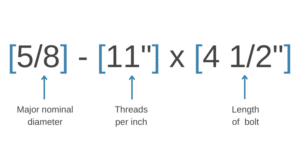
Inch Fastener Example: 5/8-11" x 4-1/2"
This format is common for inch-based bolts:
5/8 – This is the nominal major diameter of the bolt’s threads, measured in inches. It refers to the outermost diameter of the threads.
11 – This indicates the thread pitch, meaning there are 11 threads per inch (TPI).
4-1/2" – This represents the overall length of the bolt, measured from underneath the head to the tip.
So, a 5/8-11" x 4-1/2" bolt has a 5/8-inch diameter, 11 threads per inch, and is 4.5 inches long.
Metric Terminology
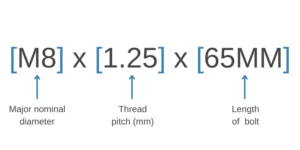
For metric fasteners, you might come across a designation like M8 x 1.25 x 65mm. Here's how to interpret it:
M8 – This indicates the nominal major diameter of the thread, which is 8 millimeters. This is the outer diameter of the bolt's threads.
1.25 – This is the thread pitch, or the distance (in millimeters) between adjacent threads. In this case, the pitch is 1.25 mm.
65mm – This is the length of the bolt, measured from underneath the head to the end of the shaft.
So, an M8 x 1.25 x 65mm bolt has an 8 mm diameter, a 1.25 mm thread pitch, and is 65 mm long.
403
0
0
All Comments (0)
Previous: None
If you are interested in sending in a Guest Blogger Submission,welcome to write for us!

Comments